Dr. Toni Hagen: The Pioneer of Nepalese Geology
Dr. Toni Hagen arrived in Nepal in 1950 as a young geologist in his early thirties, as part of a Swiss Development Assistance Mission. This initial visit provided him with the opportunity to pursue his dream of studying the geology of this largely unexplored Himalayan country. What was originally intended as a short engagement turned into a decade-long commitment that laid the foundation for Nepalese geology.
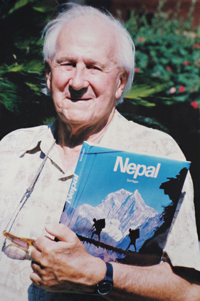
Toni Hagen with His Western Nepal Book
Within the wider geological community working in the Himalayas, few fully recognize Dr. Hagen’s pioneering role in Nepalese geology. His work during the 1950s and 1960s provided the first systematic geological framework of Nepal, shaping the understanding of its complex geology. Through extensive field surveys, documentation, and mapping, Hagen transformed geological knowledge of a country that was, at the time, largely uncharted.
Dr. Hagen’s contributions to Nepalese geology are immense and invaluable as it served as a baseline for modern research on Himalayan geology particularly in tectonics and stratigraphy. His work not only transformed Nepal’s understanding of its own geological framework but also provided critical insights for scientific research. Over more than a decade of uninterrupted fieldwork, he systematically mapped Nepal’s geology, covering over 14,000 km on foot. His work included identifying major geological structures such as the Main Central Thrust (MCT) and the Main Boundary Thrust (MBT), as well as first time recognizing the presence of nappe structures-large-scale thrust sheets formed during the Himalayan orogeny.
His landmark books, Geology of Nepal (Vol. 1, 1969) and Geology of the Thakkhola (Vol. 2, 1968), published by the Swiss Academy of Natural Sciences, remain cornerstones in Himalayan geological studies. Especially, the Geology of the Thakkhola is truly a masterpiece of pioneering
research publication on the Tethyan Himalayan zone of the Nepal Himalaya. Completing this series, Geology of Western Nepal (Vol. 3) has now been posthumously published by the Nepal Geological Society, edited by B.N. Upreti and Katrin Hagen.
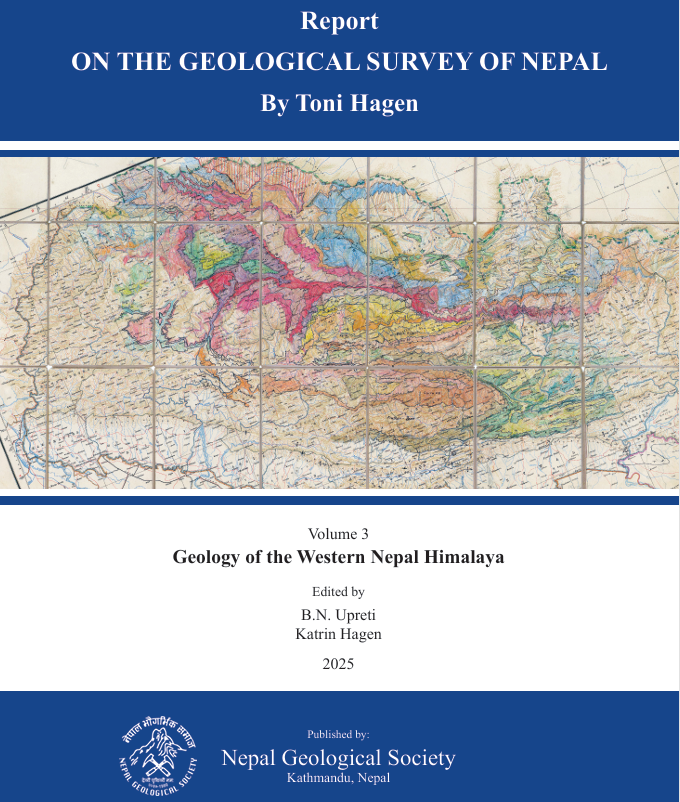
Book Cover of Geology of the Western Himalaya by Toni Hagen
The publication of Volume 3 required nearly eight years of effort. Although Dr. Hagen had largely completed the text before his passing, a significant portion remained in German and needed translation into English. His daughter, Katrin Hagen, undertook the painstaking task of finding a suitable translator and organizing maps, sketches, and photographs from Dr. Hagen’s vast archives. She also personally redrafted all sketches from his field notebooks used in this volume.
Since the manuscript in English was only a first draft, refining both the original and translated texts to ensure they accurately reflected Dr. Hagen’s intended meaning was a challenging endeavor. Katrin remained committed to preserving his original style and format, as used in Volumes 1 and 2, with minimal editing. Therefore, only essential edits were made for the purpose of clarity. However, the editors take the sole responsibility for any shortcomings or printing errors in the book. No external English-language editing was performed. At places the editors have also provided comments in italics within brackets to clarify geological terms, as well as the unfamiliar names of villages, rivers, and streams etc. that are found in the old topographic maps.
Many of Dr. Hagen’s original terminologies and naming conventions for rivers, villages, tectonic units, and geological terms were retained. For example, he used the term “pitch” instead of “plunge,” which is more commonly used today. Early European geologists in the Himalayas,
including Hagen, initially classified many unfossiliferous older Lesser Himalayan rocks as Paleozoic and Mesozoic. Readers should consider these age classifications within their historical context.
For decades, the geology of western Nepal received little attention due to its remoteness. Even today, geological information on this region remains limited compared to other parts of the country. In the mid-20th century, Nepal lacked roads, well-developed mountain trails, and bridges over rivers. Despite these extreme challenges, Dr. Hagen conducted extensive fieldwork, often lasting 5-6 months at a time, in the most remote regions of western Nepal. He braved harsh terrains, high mountain passes, food shortages, and diseases, accompanied only by a few trusted porters. In one of his books, he described facing a severe illness that nearly took his life while working in these areas. Despite these hardships, he produced detailed geological maps and pioneering studies, supported by numerous cross-sections, 3-D sketches, and high-quality photographs, making Volume 3 an exceptionally well-illustrated resource. It would have been a historic oversight if this pioneering work of Dr. Hagen-Vol.3 was not brought to light or else a wealth of geological information of western Nepal would have been missing for ever and remained unavailable to a larger geological community.
Regrettably, Dr. Hagen did not have chance to synthesize his extensive work into a comprehensive summary for this volume. Only he could have provided such an overarching interpretation, a task beyond the reach of others. However, the editors encourage readers to refer
to Volumes 1 and 2, as they contain maps, cross-sections, and abundant geological descriptions relevant to western Nepal.
Dr. Hagen’s legacy will be remembered for a long time to come and will continues to inspire new generations of researchers.